Climate
Climate change is one of the greatest threats to global development, with developing countries bearing the brunt of its impacts.
Norfund is committed to supporting a just transition to low carbon and climate resilient development – addressing both the need to reduce emissions and to adapt to a changing climate. Through our investments and active ownership, we support companies and markets in investing in climate solutions, managing climate risks, and strengthening resilience.
Since committing to the EDFI Statement on Climate and Energy in 2020, we have worked systematically to align our portfolio with a pathway towards net zero, while recognising that adaptation and transition are essential for sustainable development. In 2025, we further strengthened our approach by improving and simplifying climate assessments in the investment process, revising our Paris alignment methodology, and enhancing the quality of financed emissions data. This reflects Norfund’s ambition to deliver measurable climate impact and to support resilient, low-carbon transitions in the countries and sectors where we invest.
climate finance share of commitments in 2025
CO2e per million NOK invested
of portfolio faces material physical climate risk
Climate Strategy
In 2024, Norfund adopted a Climate Strategy for 2024–2030 covering both our development and climate mandates. The strategy sets priorities and near to medium-term actions to support low carbon and climate resilient development in developing countries. Our approach is iterative: we act now, improve continuously, and adjust as new insights emerge.
In parallel, Norfund is strengthening its focus on adaptation and resilience. We work with portfolio companies to manage climate risks and build resilience, while increasing investments in companies that deliver adaptation and resilience solutions. Together, these efforts support a just and development-oriented transition to net zero.
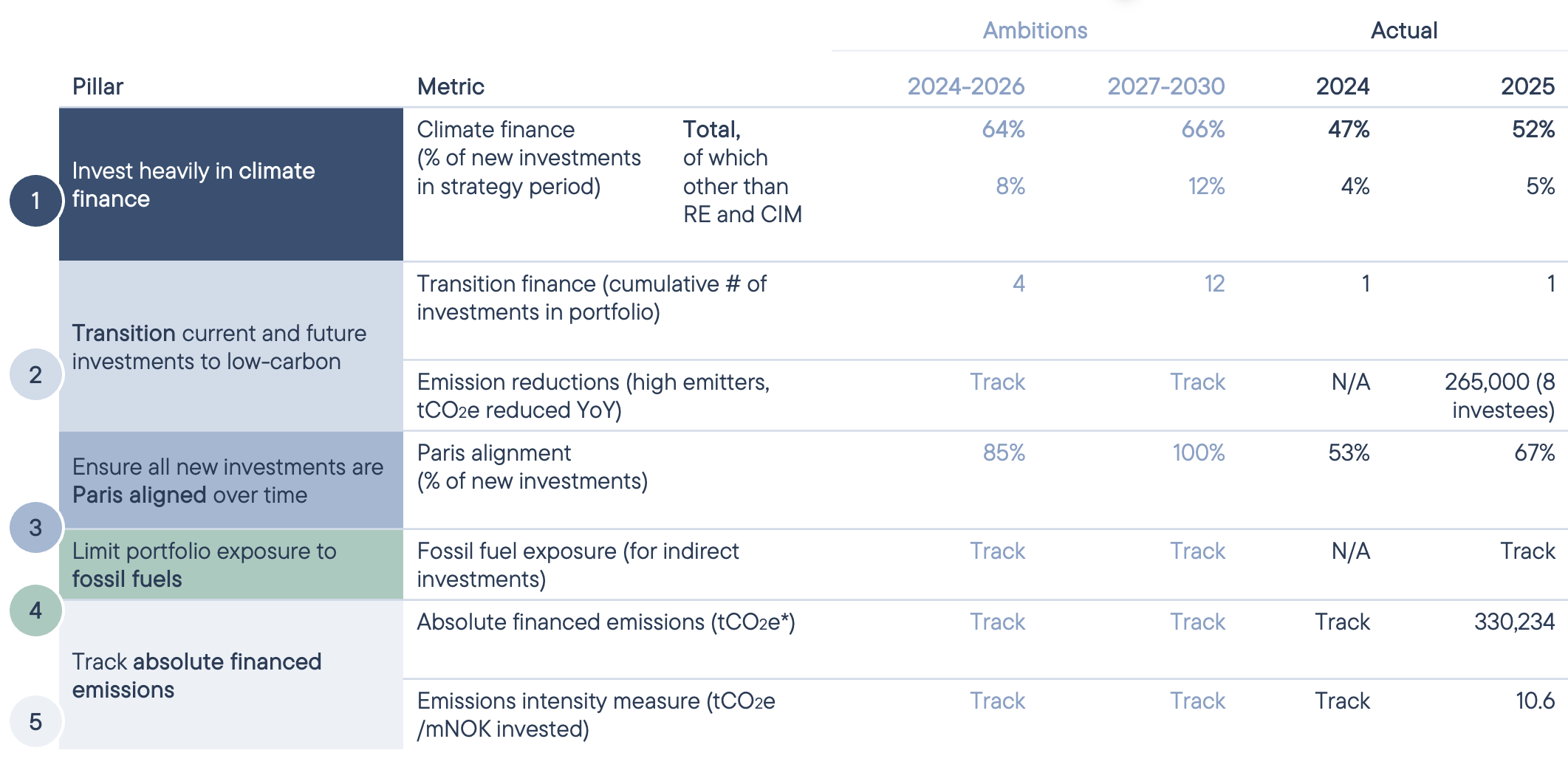
Norfund will contribute to the transition to net zero in developing countries through five main pillars:
Invest heavily in climate finance
Investing in projects and companies that contribute to mitigating or adapting to climate change is key to ensure sustainable development. Investments in renewable energy are Norfund’s largest contribution to climate finance, both through the Development mandate and the Climate investment fund. Norfund has set high ambitions for annual climate finance commitments and seeks to invest in climate finance projects across all investment areas. The criteria used to assess climate finance eligibility at Norfund are defined in the IDC/MDB’s Common Principles for Climate Mitigation Finance Tracking, and The MDB’s Joint Methodology for Tracking Climate Change Adaptation Finance. Norfund also reports in accordance with the OECD Rio Markers.
Transition current and future investments to low-carbon
Several hard-to-abate sectors are essential for continued development in the markets we operate in. Thus, investing in such sectors with the aim to reduce emissions over time (“transition finance”) is crucial to balance decarbonization and development. Norfund will also seek to apply decarbonization measures or develop transition plans for individual investments in portfolio with high emissions.
Ensure all new investments are Paris-aligned over time
Norfund has committed to aligning all new investment with the objectives of the Paris Agreement. Our methodology, developed in collaboration with other European Development Finance Institutions (EDFIs) and Multilateral Development Banks (MDBs), classifies investments as aligned, misaligned, or conditionally aligned with Paris goals. This approach enables us to effectively support investee companies in their transition toward net zero, reduce transition risks, and prevent stranded assets. Ultimately, these efforts ensure that our portfolio contributes to a sustainable and climate-resilient future.
Limit portfolio exposure to fossil fuels
Transitioning away from fossil fuels in energy systems is essential to limit emissions. Norfund has low direct exposure to fossil fuels.
The EDFIs have identified sectors and activities in which we do not invest for climate reasons. The EDFI Fossil Exclusion List provides an overview of these. In addition to this list, Norfund has further strengthened its approach to transitioning away from fossil fuels with the Norfund Fossil Fuel Standard.
Track absolute financed emissions
Norfund has chosen not to set a financed emissions target for the period 2024–2030. Instead, we expect our strategy to drive emissions reductions in the real economy, which over time should also be reflected in our financed emissions. A reduction in portfolio emissions is therefore understood as an outcome of investee decarbonisation and increased climate finance, rather than a goal in itself. Nevertheless, we will monitor our financed emissions, improve data quality and support investees in strengthening their own emissions measurement and reporting over time.
Risk management: Climate-related risks and opportunities
Norfund recognises climate change not only as an environmental challenge, but as a material driver of financial risk and opportunity in emerging markets. As a long-term investor in regions highly exposed to physical climate impacts, we integrate climate resilience throughout the investment lifecycle. In line with the structure and principles of the TCFD framework, we assess both physical and transition risks when evaluating prospective investments and identify opportunities to mitigate those risks. Where feasible, this includes working with investees to identify and implement appropriate adaptation measures.
We maintain an annual monitoring cycle to assess our portfolio’s exposure to physical and transition climate risks. As of Q4 2025, 23% of Norfund’s investments are in countries with high to very high exposure to physical climate risks, and 49% of the portfolio is assessed as having elevated physical risk.
Transition risk in the portfolio is assessed as lower, mainly due to our high share of renewable energy investments and limited climate regulation in many of our markets. As of Q4 2025, 15% of the portfolio is assessed as having medium to high transition risk.
In 2025, 52% of new commitments were invested in climate finance activities, reflecting both a clear climate-related opportunity and our strategic positioning to capture value from climate change mitigation and the shift to a low-carbon economy.
Climate assessment in the investment process
Norfund has developed a climate tool for evaluating climate risks and Paris alignment of new potential investments. The purpose is to make better and more climate-informed investment decisions, as well as future-proofing and professionalizing investees on climate by identifying opportunities and ways to reduce risk. In 2025, we started testing AI agents to support physical climate risk assessments and will look to expand this to other climate assessments as well.
The climate tool covers:
- Fossil fuel standard check
- Climate risk and opportunities assessment
- Climate maturity assessment
- Paris alignment assessment
Metrics and targets
To measure performance against the strategic pillars of our Climate Strategy, we track a set of climate-related indicators per focus area. The following section outlines our specific goals and the progress achieved:
Investee scope 1 and 2 emissions: coverage: 87% of portfolio value