Avoided emissions
In many developing markets, the realistic alternative to new renewable capacity is not no energy — it is fossil fuel-based energy. Every megawatt of clean power financed displaces greenhouse gas emissions that would otherwise occur.
Scaling up renewable energy in developing countries is one of the most effective ways to address both the climate crisis and the global development gap. Norfund invests in renewable energy in some of the world’s most carbon-intensive electricity grids, preventing millions of tonnes of CO₂ from entering the atmosphere each year. We report annually on the estimated avoided emissions from our investments.
Impact in 2025
Actual and expected avoided emissions
tCO₂e actual avoided emissions
expected tCO₂e
Methodology
Norfund estimates avoided emissions using the harmonised IFI methodology, which provides country-level grid emission factors representing the carbon intensity of each national electricity system. The methodology and datasets are available here.
The methodology distinguishes between two types of grid emission factors depending on the purpose of the calculation. For actual avoided emissions (ex-post), we apply the “operating margin” emission factor for the reporting year, which reflects the emissions of the marginal plants currently operating on the grid. For expected avoided emissions (ex-ante), we apply the “combined-margin” emission factor at the time of investment, which blends the current energy mix with forward-looking country projections from the IEA – capturing both the existing grid and the plants likely to be built or displaced in the future. In short, ex-post calculations reflect what the grid is, while ex-ante calculations reflect what the grid is expected to become.
Avoided emissions from transmission infrastructure, substations, and battery storage are not included in our calculations. Although such investments are essential to the transition from fossil energy to a higher share of renewables, no consensus methodology yet exists for calculating their climate contribution.
We also do not estimate avoided emissions from pure off-grid solutions such as solar home systems; their development impact is instead captured separately under the energy access indicator.
Actual avoided emissions
Norfund estimates avoided emissions annually based on electricity generated by renewable energy plants in our portfolio, reported by investees.
In 2025, Norfund’s portfolio companies (through both mandates) generated a total of 25,400 GWh of renewable electricity, of which 14,000 GWh came from greenfield projects. This resulted in 17.6 million tonnes of CO₂ equivalent in total avoided emissions, of which 10.3 million tonnes came from greenfield generation.
Greenfield capacity is new capacity that Norfund helped finance the construction of. Brownfield projects are existing assets that we, or a portfolio company, have invested in, where our financing supports continued operation and maintenance, but no new capacity has been added. Both generate renewable electricity that displaces fossil fuels. While Norfund helps finance the upkeep of brownfield projects and estimates total avoided emissions from the full portfolio, we place particular emphasis on greenfield avoided emissions, as these represent new clean energy that would likely not exist without our investment.
tCO₂e actual avoided emissions
tCO₂e actual avoided emissions
The chart below shows greenfield avoided emissions over the past three years, split by mandate. The Development Mandate accounts for the majority – a reflection of its long track record in financing renewable energy as part of Norfund’s broader ambition to provide energy supply and access in developing markets. In 2025, greenfield generation from the Development Mandate alone avoided over 7.1 million tonnes of CO₂ equivalents.
The Climate Investment Fund, operational only since 2022, is still in its build-out phase. 48% of its investments are under construction and have yet to begin generating. Even so, the fund contributed over 3.1 million tonnes in greenfield avoided emissions in 2025. Once all committed projects reach operation, they are expected to generate more avoided emissions annually than the Development Mandate – a reflection of the scale and carbon intensity of the markets the Climate Investment Fund targets.
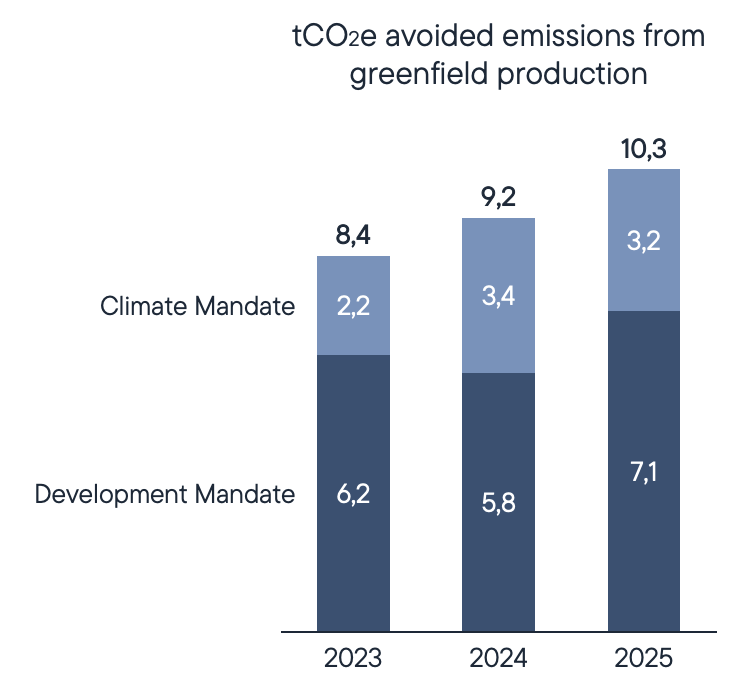
A small decline in greenfield avoided emissions in the Climate Investment Fund from 2024 to 2025 is largely explained by the exit of a company that was a significant contributor. Following the exit, the annual avoided emissions no longer appear in Norfund’s portfolio figures – but the plant is still fully operational and continues to displace fossil fuels.
Expected avoided emissions
The Climate Investment Fund was established to finance renewable energy at scale in the markets where it matters most for the climate – countries whose electricity grids are dominated by coal and other fossil fuels.
When the mandate became operational in 2022, it had no existing portfolio and no operational plants. Reporting actual avoided emissions was not yet possible, so the mandate needed a metric that could demonstrate strategic direction and hold it accountable before a single turbine was turning.
The answer was “expected avoided emissions” – an ex-ante figure calculated at the time of investment, based on planned capacity and expected generation, figures that are always an important part of an investment decision due to its direct connection to financial viability of a project.
The mandate’s impact ambition for the 2022–2026 strategy period was 14 million tCO₂e in expected avoided emissions. That target was exceeded already by the end of 2023. By end of 2024, the cumulative figure stood at 17.6 million tCO₂e.
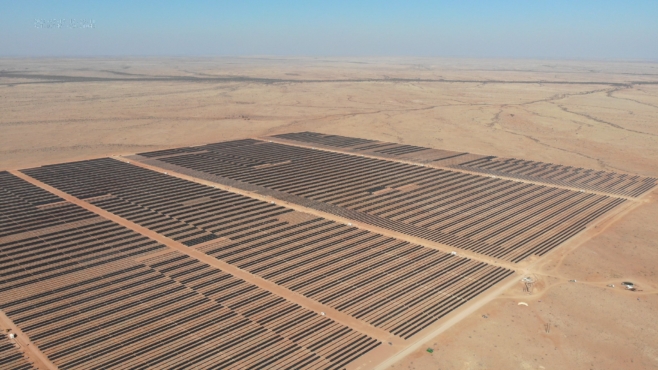
The expected avoided emissions from investments made in 2025 alone were 22.7 million tons. The high number is mainly the result of investments in two large-scale power generation platforms in South Africa. Their combined planned capacity is substantial, and because they will feed into one of the world’s most carbon-intensive grids, the avoided emissions per megawatt are expected to be exceptionally high.
tCO₂e expected avoided emissions from 2025 investments
share of financed capacity under construction
From pipeline to performance
As the Climate Investment Fund enters its sixth year, the portfolio is maturing. Several projects financed in its early years are now operational and generating electricity — contributing to the actual avoided emissions reported in the first section. The balance between projected and actual results will continue to shift as more of the pipeline moves from construction to operation.
Looking at investments from 2022 (the mandate’s first year) it is now possible to compare the expected avoided emissions calculated at the time of investment with actual generation data. Two of the companies are already avoiding more emissions than originally projected, and one is performing broadly in line with expectations. The remaining two have experienced construction delays — something that is not uncommon in the markets where we operate, where infrastructure timelines are often subject to permitting, grid connection and supply chain challenges.
Attribution
As with all Norfund’s reported development effects, the avoided emissions figures reported above are gross figures from Norfund-financed portfolio companies, not attributed to Norfund’s financed contribution.
As most investors, Norfund calculates financed emissions from our portfolio using the PCAF standard, which attributes emissions to investors proportionally based on ownership percentage or loan share relative to total company assets. Applying the same logic to avoided emissions would however not take into account Norfund’s additionality.
Our role as a development finance institution is to invest where commercial capital will not go alone — to be the investor that makes a project possible, not merely a participant in a project that would have proceeded regardless. When that is the case, the relevant counterfactual is not a proportionally smaller version of the project, but no project at all. Norfund is also set up to mobilise private capital, but with a pro-rata approach, the more successfully we mobilise private capital, the smaller the attributed share would be counted.
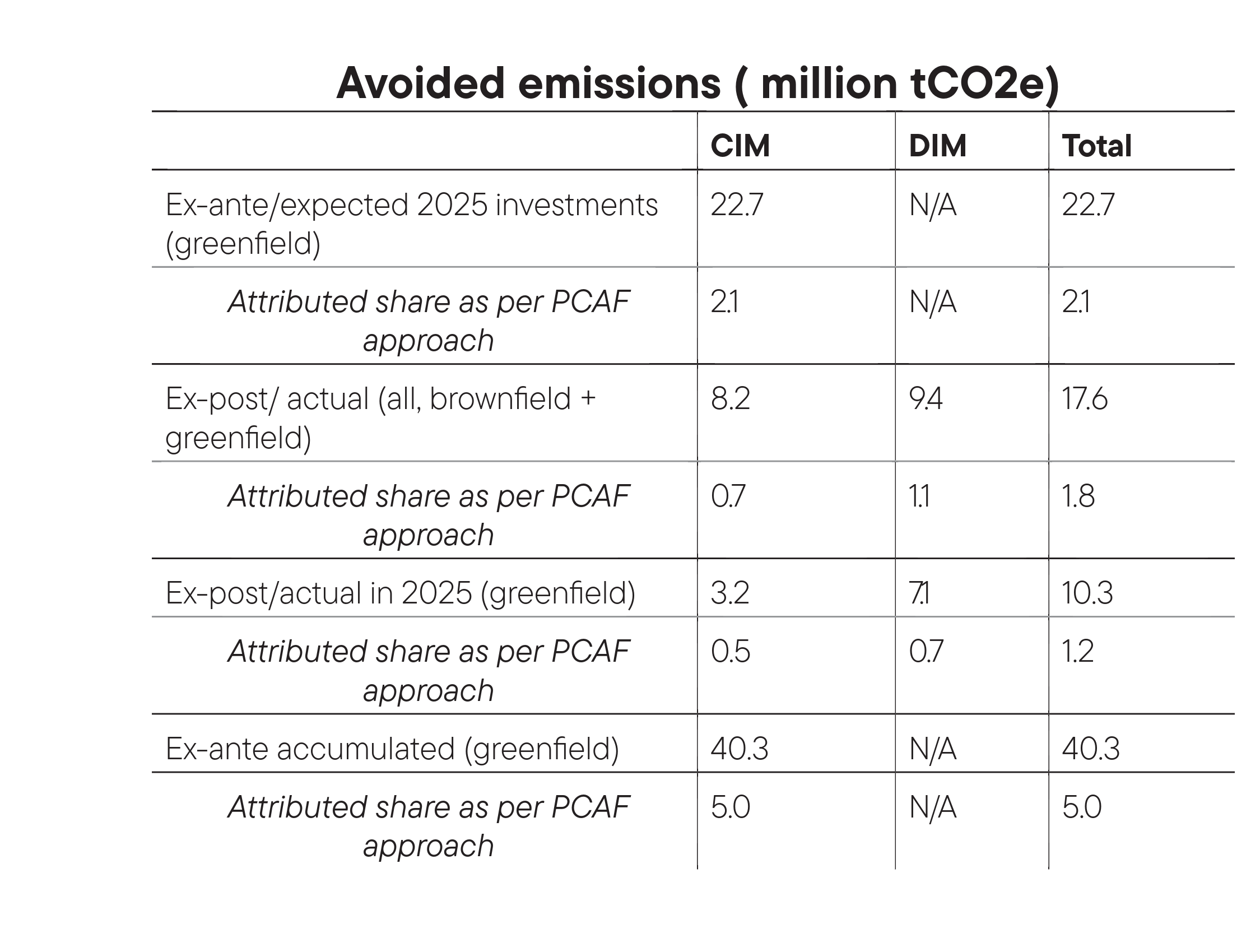
Norfund therefore reports avoided emissions on a gross, unattributed, basis as the primary indicator. However, in the table below, we chose to also present a PCAF-attributed figure as a complementary measure. The gross figure captures the actual climate outcome; the attributed figure reflects our proportional financial stake. Neither alone tells the full story of Norfund’s impact. Finding the most appropriate methodology is discussed across the industry, and actors and initiatives like GIIN, OECD DAC, Impact Reporting Norms, and the IFC’s Operating Principles for Impact Management are all engaged in this challenge.

 September 22, 2025
Climate Investment Fund to finance new major South African renewable actor
 January 23, 2024