
All investments approved in 2025 have been assessed under a framework aligned with the OECD-DAC Private Sector Instrument (PSI) taxonomy, the international standard for reporting ODA-funded private sector investments. Of 59 investments assessed in 2025, representing NOK 8.4 billion in committed capital, all demonstrated additionality on at least one criterion.
The framework
Since 2018, Norfund has assessed the additionality of all new investments prior to commitment. The framework has been revised twice over this period and was updated again in 2024 to align with the PSI taxonomy, the standard that governs how Norway’s ODA contributions through Norfund are reported internationally. The 2025 portfolio is the first to be reported in full under the new structure.
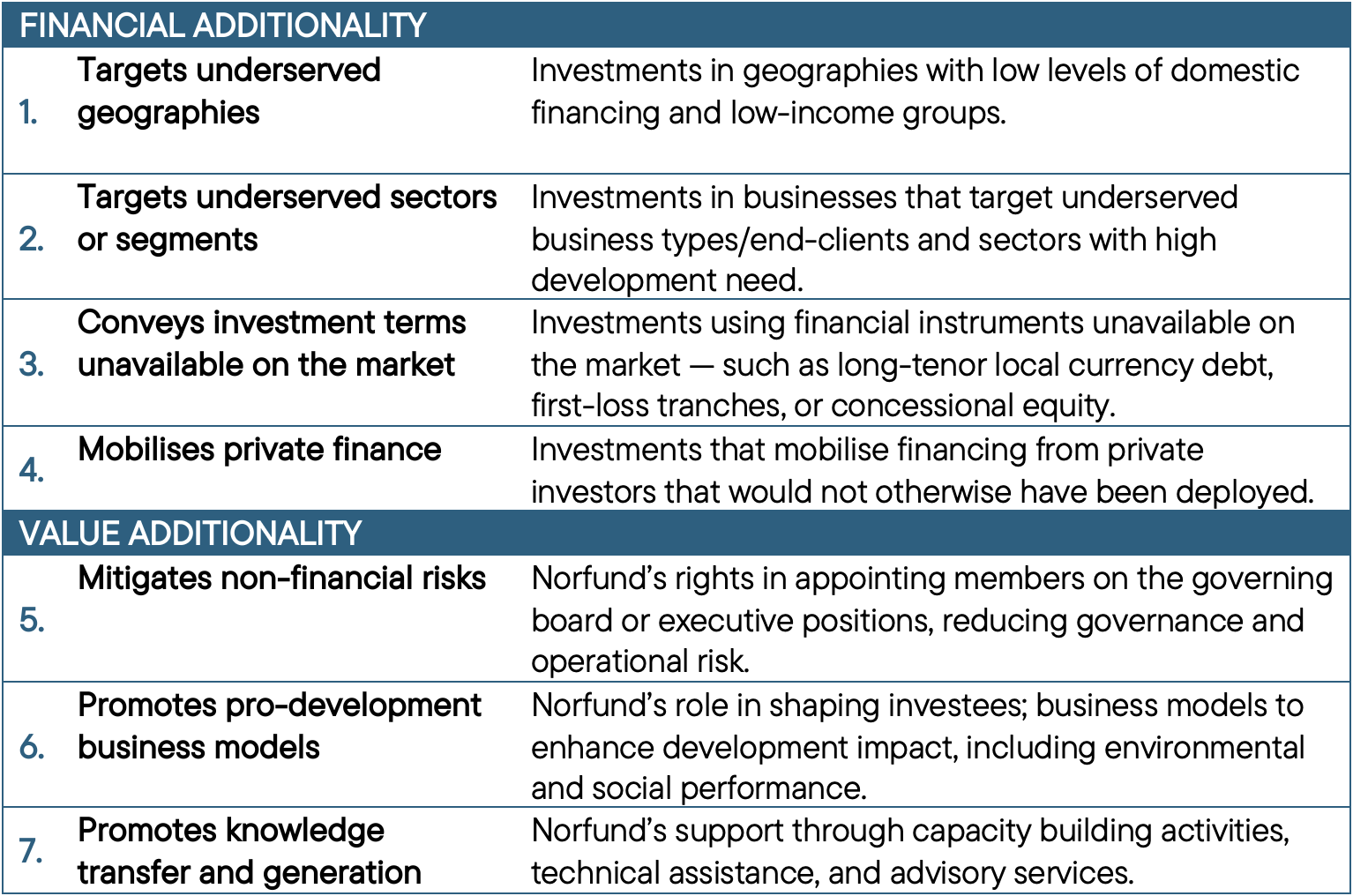
The framework organises additionality across seven criteria: four relating to financial additionality and three to value additionality. This replaces the previous structure of ten ambitions. While the underlying principles are unchanged, the consolidation of criteria means direct year-on-year comparisons with pre-2024 results are not entirely straightforward.
The assessment logic remains the same: a positive score on any one of the seven criteria is sufficient for an investment to be considered additional. The seven criteria are:
Key observations from 2025
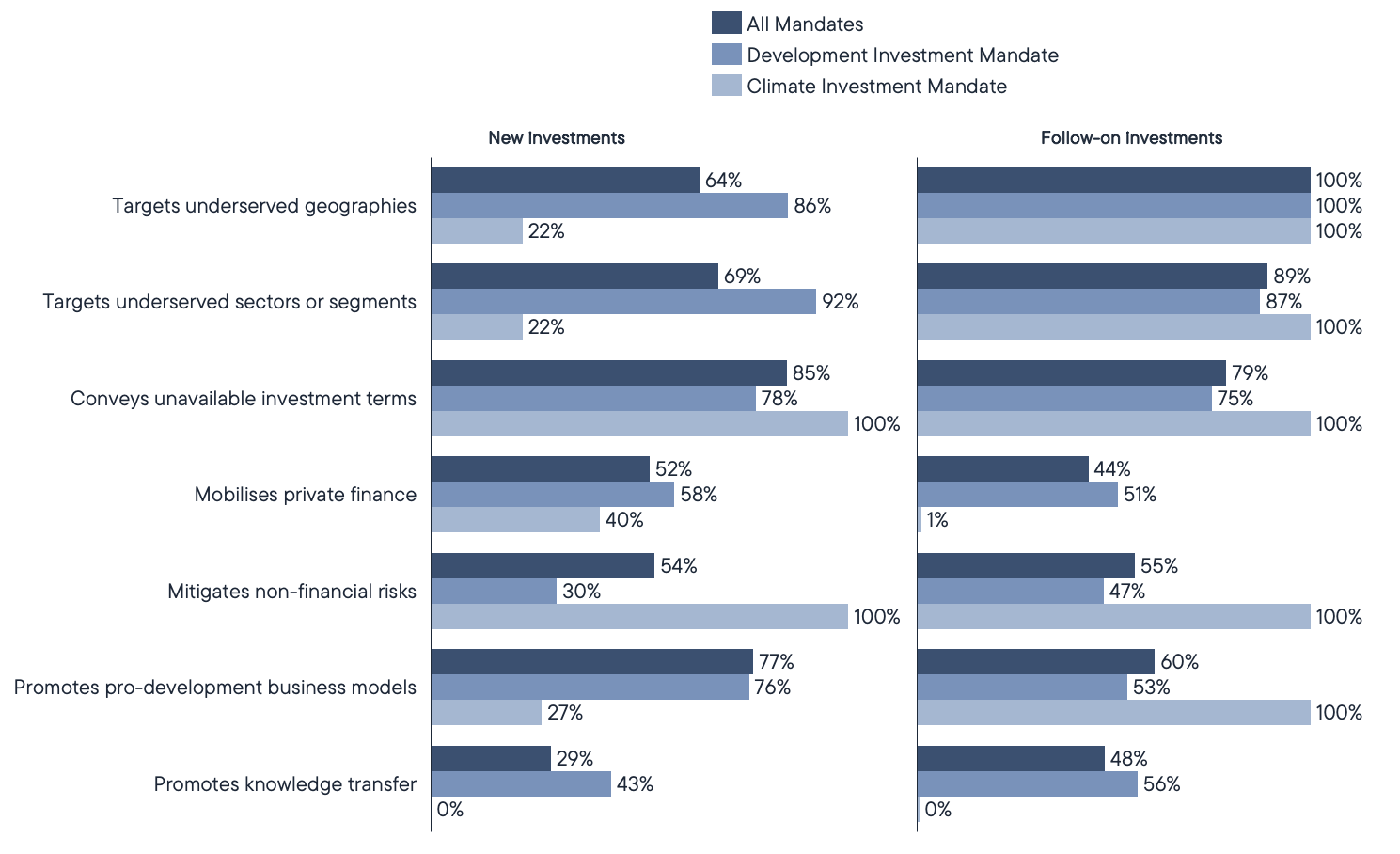
All new and follow-on investments are subject to a formal additionality assessment prior to commitment. The figure below shows the share of new, and follow-on committed capital scoring positively on each criterion in 2025, disaggregated by mandate.
Share of committed capital for new and follow-on investment by Norfund mandate*
Share of committed capital for all investment by Norfund mandate*
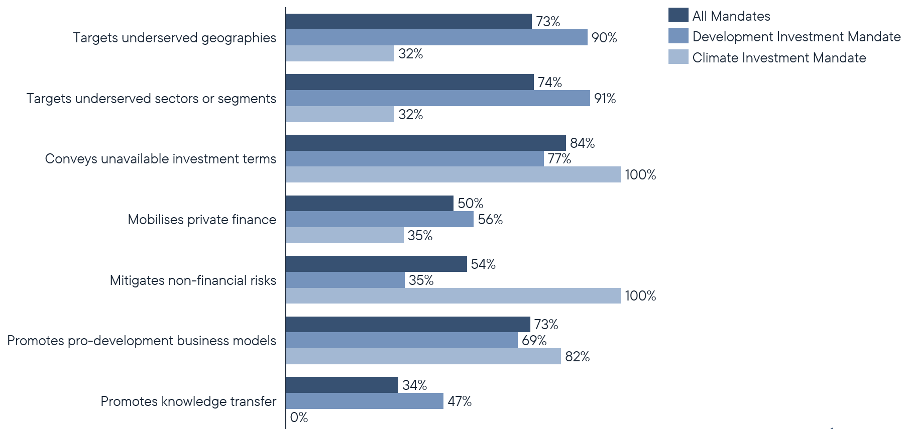
*The Ukraine Investment Mandate, established in December 2024, is not included in the committed capital analysis above. As a nascent mandate with a limited number of investments in its first year of operation, its inclusion would not yet be representative of the mandate’s intended additionality profile. Norfund expects to report on Ukraine mandate additionality more fully as the portfolio matures.
Criterion 3 (conveying investment terms unavailable on the market) was the most widely met financial additionality criterion across the portfolio. This reflects Norfund’s continued use of instruments such as local currency debt, long tenors, and first-loss tranches in markets where these are not available commercially. Local currency financing was deployed in Tanzania, Kenya, Nigeria, Ivory Coast, Guatemala, and Indonesia.
Sub-Saharan Africa accounted for 64% of total committed capital, approximately NOK 5.33 billion across 34 transactions, consistent with Norfund’s strategic focus on the region. A significant share was also directed to Least Developed Countries. Six investments carried exposure to fragile or conflict-affected states, including Mali, the Central African Republic, South Sudan, the Democratic Republic of Congo, and Ethiopia.
Every investment that scored on value additionality also scored on at least one financial additionality criterion, meaning that this year, value contributions were complementary to, rather than a substitute for, a financial additionality case.
Results by mandate
The distribution of criteria across the two mandates reflects their different investment profiles.
Under the Climate Investment Mandate, 100% of committed capital scored on Criterion 3 (unavailable investment terms) and Criterion 5 (governance and risk mitigation), driven by the equity-led nature of large renewable energy projects in emerging markets.
Under the Development Investment Mandate, Criteria 1 and 2 — targeting underserved geographies and sectors — scored more broadly, reflecting wider country exposure and a high share of transactions directed at micro, small, and medium enterprises (MSMEs) and low-income households.