Development Mandate
The goal of Norfund’s original Development Mandate is to create jobs and improve lives by investing in businesses that drive sustainable development.
Creating jobs, improving lives
Through the Development Mandate, Norfund invests in companies that will contribute to economic and social development impact through:
- the taxes they pay
- the direct and indirect jobs they provide and the income these give
- the goods and services they offer
Geography for the Development Mandate
We prioritise 31 core countries where Norfund's risk capital can have the greatest impact in line with the Development Mandate: to create jobs and improve lives.
Development effects
Norfund’s investments create impact far beyond what we can capture in data, but we systematically track these five development effect categories.





Strategy
At the core of the Development Mandate strategy is the ambition to be additional, by investing where capital is scarce and risks deter other investors, and by contributing non‑financial value through expertise and responsible ownership. We aim to deliver impact through targeted asset allocation. By exiting mature investments, we recycle capital and increase our impact.
Investment areas
Norfund invests in four areas identified to have substantial potential to contribute to direct and indirect job creation and improved lives in developing countries.
Access to electricity and finance are crucial for growing businesses. Scalable enterprises are companies with significant potential to grow and create more jobs, while sustainable infrastructure underpins resilient communities and long-term development.


Impact ambitions
Norfund has defined two impact ambitions for each investment area within the development mandate for the strategy period 2023–2026. The following figure provides a summary of progress towards these ambitions as of year-end 2025, marking the conclusion of the third year in the strategy period.
The ambitions for financial inclusion and scalable enterprises are based on year-over-year changes in companies that have reported for two consecutive years and reflect net figures. Regarding renewable energy under the development mandate, the ambitions relate to the actual number of households provided with electricity access through Norfund’s off-grid investments and the expected new capacity financed as a result of Norfund’s involvement.
Overall, most investment areas are on track to exceeding the impact ambitions set for the current strategy period.
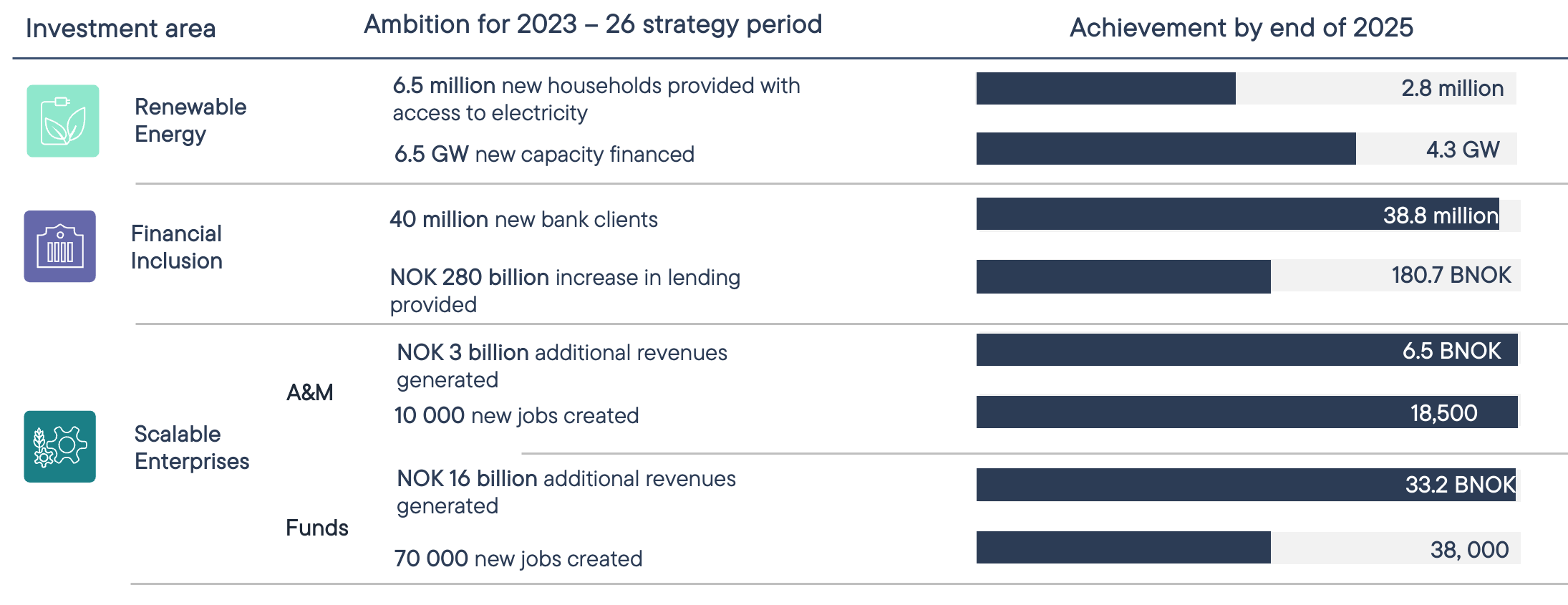
We disclose data only when at least five companies report on the same indicator two subsequent years. Therefore, we do not publish impact achievement for Green Infrastructure.
Key Performance Indicators
As part of Norfund’s strategy, we have four KPIs at portfolio level aligned with our mandate and related to our additionality.
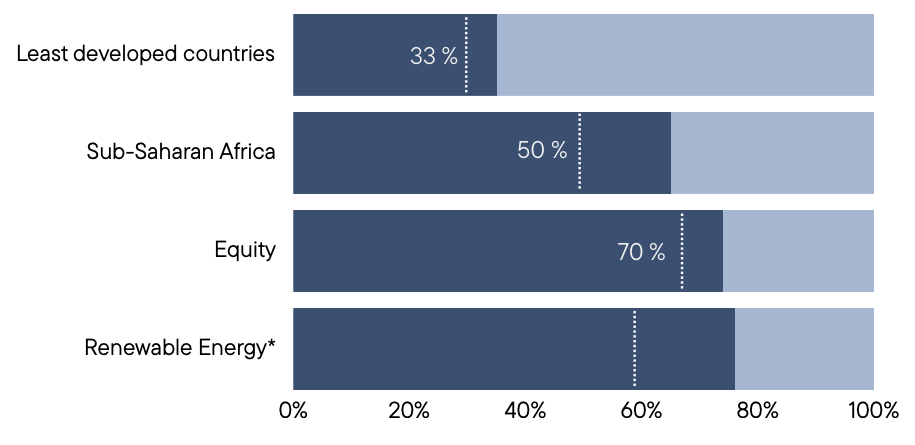
The renewable energy KPI at 60% is defined as total RE-commitments (at commitment date fx-rate) divided by total allocation from the MFA, starting from 2022.
Priority instruments
Norfund provides capital in the form of equity, debt and fund investments. Preference is given to equity investments, as this remains the scarcest form of capital in developing countries. Provision of debt to financial institutions increases the ability of companies to provide loans to clients. Debt investments also diversify Norfund’s portfolio, both in terms of risk and capital reflows. Investing in funds via trusted and skilled partners is a way to channel capital to companies that may be difficult to invest in directly, due to size, sector or market. Norfund targets a minimum of 70% equity.