
An essential part of Norfund’s mandate is to support the creation and expansion of viable and sustainable businesses, providing jobs and revenue streams in developing countries. The aim is to exit an investment when Norfund is no longer additional, so that others can take over. Capital can then be circulated into new businesses, increasing the impact of each krone allocated to Norfund through the aid budget.
Norfund invests in robust businesses that will have a lasting impact on their country and community. At the same time, capital is needed to promote higher risk projects that might have a large impact if they succeed, but a larger probability of failure. To investigate delivery on the mandate, and balance of risk-taking, we conduct an analysis of Norfund’s exited companies by end 2025, 111 in total.
The analysis
The analysis from 2025 is the fourth of its kind, with previous analyses having been completed in 2015, 2019 and 2022.
Remain operational
A company remains operational if there are clear indications that activities continue at a reasonable level.
Performance
Company performance in job creation, financial indicators and other development impacts, tracked during holding period and 3 years post-exit. All financial numbers have been inflation adjusted to give a true picture of growth.
The data
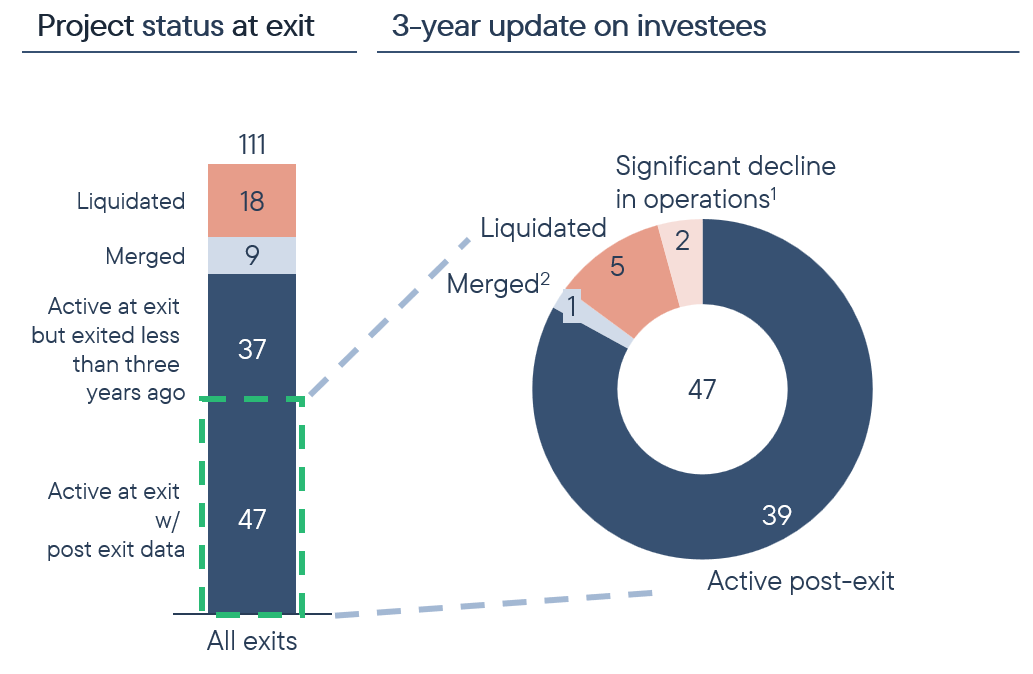
The dataset consists of 111 exits in total, of which 47 have passed the 3-year post-exit threshold. The distribution across regions and departments largely mirrors that of Norfund’s current portfolio.
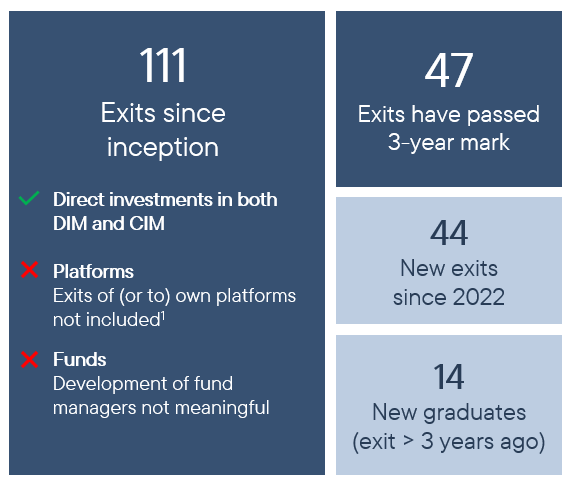
Note: Funds and platforms are not included in the analysis due to complexity, unclear exit classification, and small share of project count.
Key results
1. Most investments remain operational, both during and after Norfund ownership
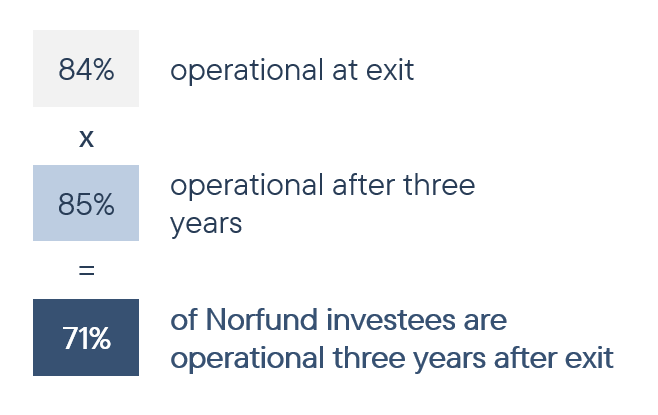
When Norfund exits, 84% of projects are operationally active.
Combining the operational rates seen during ownership and after exit indicate that 71% of all projects are operational three years after exit.
2. Investees exhibit growth in key impact indicators, both during holding and post-exit
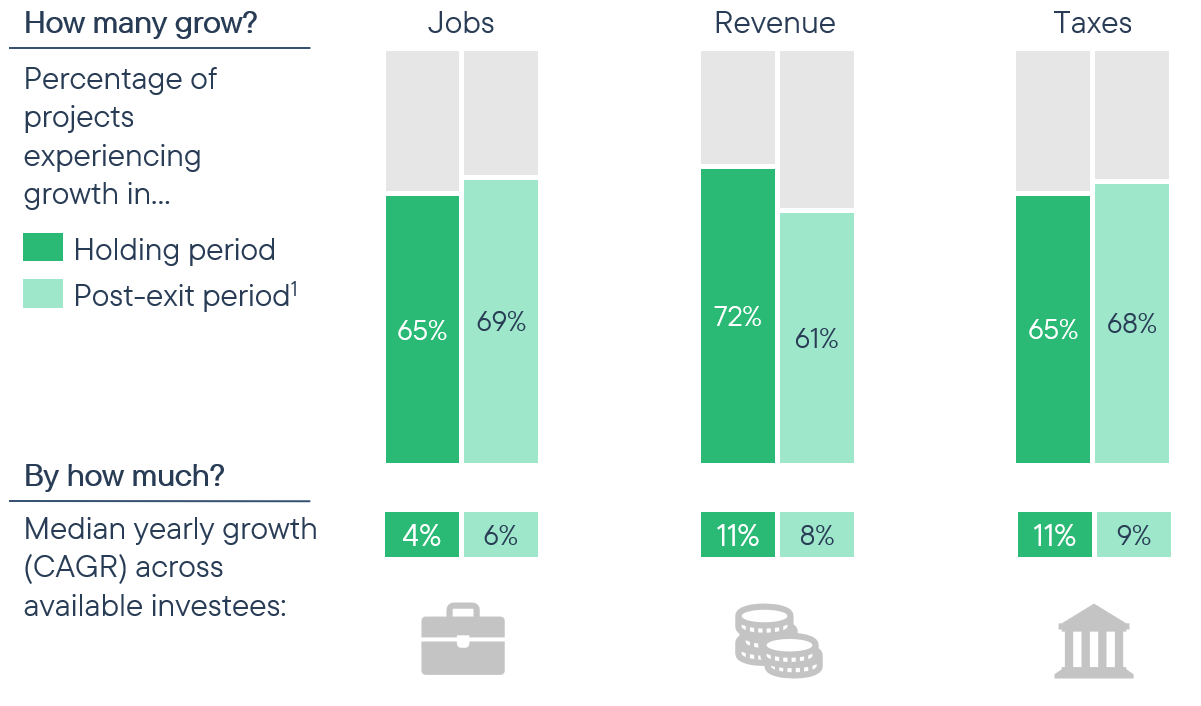
Three key indicators have been chosen to represent growth among Norfunds investees: Direct jobs shows how Norfunds investees contribute to work opportunities in local communities, revenue shows how Norfund investees deliver value creation, and total taxes paid represent the direct effect on local governments.
This analysis has added inflation adjustments, achieving an even clearer picture of project trajectories.
Across all indicators, 60-70% of Norfund’s investees grow. Annualized growth during holding period is 4% for jobs, and in the double digits for both revenue and taxes.
Projects also experience growth post-exit, aligning with our goal of achieving lasting and sustainable impact.
3. Rising number of exits
Exiting projects means that Norfund can reuse capital to fund other projects, leading to a higher impact.
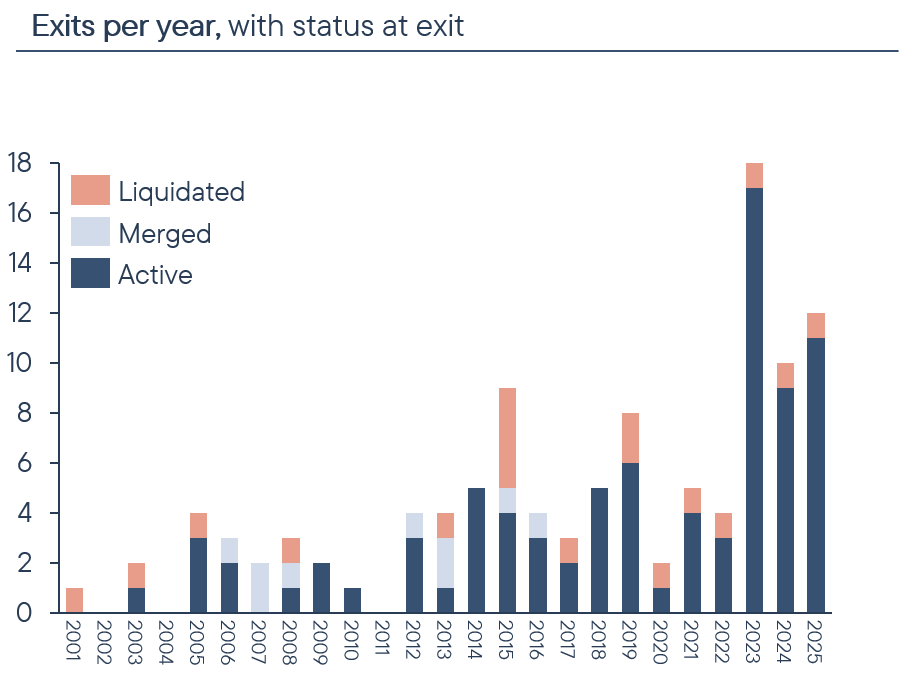
Exits have been a priority in later years, and average exits per year has increased: The last three years saw an average of 13 exits per year, while the ten year average is 7.
Since inception, liquidations as share of exits have fallen, suggesting an improved capability of choosing and developing projects or change in strategy.
Data limitations
The current analysis is undertaken primarily as a self-assessment and learning tool and has several data limitations. As such, the results are considered indicative, rather than conclusive.
There are plans to expand and improve on the dataset in the future to address these limitations and over time make findings more robust. Limitations include:
- Limited number of observations
- Data quality limitations